Executive Summary
stitchwand is the definitive design token toolchain and companion application for Google Stitch, the AI-native design platform. We convert, validate, and diff design tokens across every format, giving design system teams a single source of truth from Figma to production.
The Opportunity
Google Stitch is creating a new category of AI-native design tooling. As the first dedicated companion app, stitchwand is positioned to become the infrastructure layer that connects Stitch to every design system, codebase, and CI pipeline. We are building the rails.
Strategic Pillars
Pillar 1
Free CLI & SDK
Ship a best-in-class CLI and TypeScript SDK as free npm packages. Earn trust. Win npm mindshare. Build adoption gravity before monetizing. The CLI is the wedge; the ecosystem is the moat.
Pillar 2
Stitch-Native Experience
Deep integration with Google Stitch via Skills marketplace. First-mover as the token management companion. Ride the Stitch adoption curve with purpose-built workflows that feel native to the platform.
Pillar 3
MCP-First Architecture
Ship an MCP server that lets any AI agent convert, validate, and diff tokens. Position stitchwand as the design token API for the agentic era. Every agent that talks design tokens talks through us.
Go-to-Market Timeline
| Phase |
Timeline |
Focus |
Key Milestone |
| Phase 1 |
Q2 2026 |
Free tools foundation |
1,000 npm weekly downloads |
| Phase 2 |
Q3 2026 |
Web app + Stitch ecosystem |
500 beta users, Stitch Skills listing |
| Phase 3 |
Q4 2026 |
Monetization + MCP |
$25K MRR, MCP directory listing |
| Phase 4 |
Q1 2027 |
Team + Enterprise |
$100K MRR, 3 enterprise pilots |
Core Value Proposition
For Design System Leads
Single Source of Truth
Convert tokens between any format (DTCG, Style Dictionary, Figma Variables, CSS custom properties). Validate against your schema. Diff changes before they ship. Never have a token mismatch in production again.
For Developers
Tokens in Your Workflow
CLI in your terminal, MCP server in your AI editor, web app for visual review. Run npx stitchwand convert and get production-ready output. No config files. No build step. It just works.
Market Analysis
The design tooling market is undergoing a structural shift. AI-native platforms like Google Stitch are rewriting the rules. Design tokens are emerging as the critical interoperability layer, and no dedicated toolchain has captured the category.
Market Sizing
$4.2B
Total Addressable Market
$680M
Serviceable Addressable
$48M
Serviceable Obtainable (Y3)
TAM — $4.2B
Global Design Tool Market
The total design tool market includes UI design platforms, prototyping tools, design system management, handoff tools, and design ops infrastructure. Growing at 14.2% CAGR driven by AI-native tooling adoption and enterprise design ops investment.
- UI design platforms (Figma, Sketch, Adobe XD)
- Design system management (Storybook, Zeroheight)
- Design-to-code and handoff tools
- Visual testing and QA (Chromatic, Percy)
- AI-native design platforms (Google Stitch)
SAM — $680M
Design Token & System Infrastructure
The serviceable market narrows to teams that actively manage design tokens and need tooling for conversion, validation, and synchronization. This includes enterprise design ops, agencies with multi-brand systems, and teams adopting Google Stitch.
- ~45,000 companies with mature design systems
- ~12,000 agencies managing multi-brand tokens
- Average contract value: $5,200/year
- Growing as DTCG standard gains adoption
Growth Drivers
Tailwind
DTCG Standard Adoption
The W3C Design Tokens Community Group specification is reaching maturity. As the standard gets adopted by tools like Figma and Stitch, demand for conversion and validation tooling will surge. stitchwand is built DTCG-first.
Tailwind
AI-Native Design Wave
Google Stitch represents a paradigm shift. AI-generated designs need programmatic token management at a scale human workflows never required. stitchwand automates what would otherwise be manual token cleanup and validation.
Tailwind
MCP Ecosystem Expansion
The Model Context Protocol is becoming the standard for AI tool integration. Every code editor, every agent platform is adopting MCP. An MCP server for design tokens is a greenfield opportunity with zero incumbents.
Market Segments
| Segment |
Size |
Urgency |
Willingness to Pay |
Our Fit |
| Enterprise Design Ops |
~8,000 companies |
High |
$$$ |
Excellent |
| Mid-Market Product Teams |
~22,000 companies |
Medium |
$$ |
Strong |
| Agencies / Studios |
~12,000 agencies |
Medium |
$$ |
Strong |
| Indie Developers |
~200,000 devs |
Low |
$ |
Good (OSS wedge) |
| Google Stitch Early Adopters |
~15,000 users (est.) |
High |
$$ |
Excellent |
Key Market Trends
Trend
Design Systems Are Infrastructure
Design systems have evolved from style guides to engineering infrastructure. Tokens are the atomic unit. Companies now treat token pipelines with the same rigor as CI/CD for code. This creates demand for dedicated tooling, linting, and validation.
Trend
Multi-Platform, Multi-Brand
Enterprises maintain tokens across web, iOS, Android, and multiple sub-brands. The conversion problem is compounding. Teams need to output from a single source to 5-10 target formats. Manual conversion is unsustainable.
Target Personas
Four primary personas drive adoption and purchasing decisions. Each has distinct pain points and motivations that inform our messaging, channel strategy, and feature prioritization.
DS
Primary Buyer
Design System Lead
Senior IC or manager responsible for the design system at a mid-to-large company. Manages token libraries, component documentation, and cross-team adoption. Reports to VP of Design or Head of Engineering.
Pain Points
- Token drift between Figma and code — values diverge after every sprint
- No automated validation — broken tokens reach production
- Manual conversion between formats takes hours per release
- Difficult to audit changes across the full token tree
Motivations
- Wants a single source of truth that designers and devs both trust
- Needs to prove design system ROI to leadership with metrics
- Looking for tools that integrate into existing CI/CD pipelines
- Excited by AI-native workflows that reduce manual token management
FE
Primary User
Frontend Developer
Mid-to-senior frontend engineer who consumes design tokens in React, Vue, or native apps. Cares about developer experience, type safety, and clean APIs. Uses VS Code or Cursor with AI coding assistants daily.
Pain Points
- Token files are poorly typed — autocomplete is broken or missing
- No way to validate tokens in CI — broken styles ship silently
- Converting Figma exports to usable code requires custom scripts
- AI coding assistants don't understand the design token context
Motivations
- Wants a CLI that fits into existing terminal workflows
- Values type-safe TypeScript output with zero config
- Excited by MCP integration — tokens accessible to AI editors
- Prefers dedicated tools purpose-built for their workflow
DO
Budget Holder
Design Ops Manager
Operations-focused role at an enterprise or large scale-up. Manages tooling budgets, vendor relationships, and workflow automation for 20-100+ designers. Cares about efficiency, compliance, and measurable outcomes.
Pain Points
- No visibility into token usage across teams and brands
- Compliance requirements demand audit trails for design changes
- Onboarding new team members to the token workflow takes weeks
- Vendor sprawl — too many point solutions, no unified platform
Motivations
- Needs team analytics and usage dashboards
- Wants SSO and audit logs for enterprise compliance
- Looking to consolidate tooling and reduce vendor count
- Values solutions that demonstrate clear time savings
CD
Influencer
Agency Creative Director
Leads creative teams at a digital agency or design studio. Manages 3-10 client brands simultaneously, each with their own design system and token library. Early adopter of AI design tools including Google Stitch.
Pain Points
- Managing tokens across multiple client brands is chaotic
- Handoff to client dev teams loses fidelity in token translation
- AI-generated designs (Stitch) create tokens that need cleanup
- No efficient way to compare token sets between design iterations
Motivations
- Wants to position the agency as Stitch-ready for clients
- Needs multi-brand workspace to manage client portfolios
- Values visual diff tools that clients can understand
- Interested in AI-powered token generation and auditing
Persona Prioritization Matrix
| Persona |
Influence |
Budget |
Urgency |
Phase |
Primary Channel |
| Design System Lead |
Very High |
Medium |
High |
Phase 1-2 |
npm / GitHub / Twitter |
| Frontend Developer |
High |
Low |
Medium |
Phase 1 |
npm / Dev.to / MCP directory |
| Design Ops Manager |
High |
High |
Medium |
Phase 3-4 |
Content / Conferences / Sales |
| Agency Creative Dir. |
Medium |
Medium |
High |
Phase 2-3 |
Stitch community / Dribbble |
Distribution Channels
A multi-channel strategy prioritizing developer-led adoption in early phases, expanding to content and partnership-driven growth as the product matures.
Channel Strategy Philosophy
Lead with the free CLI. Earn trust through npm before asking for money. Every channel reinforces the same narrative: stitchwand is the token infrastructure you didn't know you needed.
Primary Channels
P0 — Launch Channel
npm Packages
The foundational distribution channel. The CLI and core library published as free npm packages. This is the top-of-funnel that feeds every other channel.
- Publish @stitchwand/cli and @stitchwand/core to npm
- Clear README, examples, and documentation site
- GitHub Actions integration template for CI/CD pipelines
- Weekly release cadence with semantic versioning
- Target: 2,500 npm weekly downloads by end of Phase 2
P0 — Strategic Channel
Google Stitch Ecosystem
First-mover advantage as a Stitch Skills marketplace listing. Direct access to every Stitch user. Our most strategic channel for product-market fit validation.
- Stitch Skills marketplace listing with rich documentation
- Pre-built Stitch-to-DTCG conversion workflows
- Featured in Stitch community tutorials and guides
- Partnership with Google Stitch developer relations team
- Target: Featured Skill listing by end of Phase 2
P0 — Growth Channel
MCP Ecosystem
List the stitchwand MCP server in every major MCP directory. Get design token capabilities into Cursor, Claude, Windsurf, and every AI coding agent.
- MCP server published to npm and listed in official directories
- Integration guides for Cursor, Claude Desktop, Windsurf
- Showcase in "awesome-mcp" lists and community resources
- "Design tokens for your AI editor" positioning
- Target: 500 MCP server installations by end of Phase 3
P1 — Authority Channel
Content Marketing
Technical blog posts, tutorials, and video content establishing stitchwand as the thought leader in design token infrastructure. SEO-driven evergreen content.
- Weekly blog: token tutorials, Stitch workflow guides, case studies
- YouTube: "Token in 60 Seconds" shorts, deep-dive tutorials
- Guest posts on Smashing Magazine, CSS-Tricks, Dev.to
- SEO targeting: "design token converter", "DTCG validator"
- Target: 10K monthly blog visitors by end of Phase 3
P1 — Community Channel
Community
Build a community of design system practitioners and token enthusiasts. Discord for real-time support, Twitter/X for reach, conferences for credibility.
- Discord server with channels for support, showcase, RFC discussion
- Twitter/X: daily tips, release announcements, token hot takes
- Conference talks: Config, Clarity, An Event Apart, Smashing Conf
- Monthly community call with roadmap previews
- Target: 1,500 Discord members by end of Phase 3
P2 — Expansion Channel
Partnerships
Strategic integrations with adjacent tools in the design ecosystem. Figma plugin, Storybook addon, and co-marketing with complementary products.
- Figma plugin: export Variables as stitchwand-validated tokens
- Storybook addon: display token metadata alongside components
- Integration with Vercel, Netlify for design token preview deploys
- Co-marketing with complementary tools (Chromatic, Zeroheight)
- Target: 3 signed partnership deals by Phase 4
Channel Investment by Phase
| Channel |
Phase 1 |
Phase 2 |
Phase 3 |
Phase 4 |
| npm Packages |
Heavy |
Heavy |
Medium |
Medium |
| Stitch Ecosystem |
Medium |
Heavy |
Heavy |
Heavy |
| MCP Ecosystem |
Light |
Medium |
Heavy |
Heavy |
| Content |
Light |
Medium |
Heavy |
Heavy |
| Community |
Medium |
Medium |
Heavy |
Heavy |
| Partnerships |
Light |
Light |
Medium |
Heavy |
Pricing Strategy
Free-tier plus paid upgrades: free CLI and core library for individual developers, paid tiers for teams and enterprises. The free tier is a genuine product, not a trial. Pro unlocks power features; Team unlocks collaboration; Enterprise unlocks compliance.
Free
$0
For individual developers and personal projects. Full CLI + core library, forever free.
- CLI with convert, validate, diff commands
- All token format conversions (DTCG, CSS, Style Dictionary, Figma)
- Schema validation with built-in rules
- Token diffing with visual output
- TypeScript SDK (@stitchwand/core)
- Community support (Discord, GitHub Issues)
- Unlimited local usage
- Starter Kits, Design Swarm, Documents locked (visible with lock icons + "Pro" badge)
Pro
$19 /mo
For design system leads and power users who need the full web experience.
- Everything in Free
- Web app with visual token editor
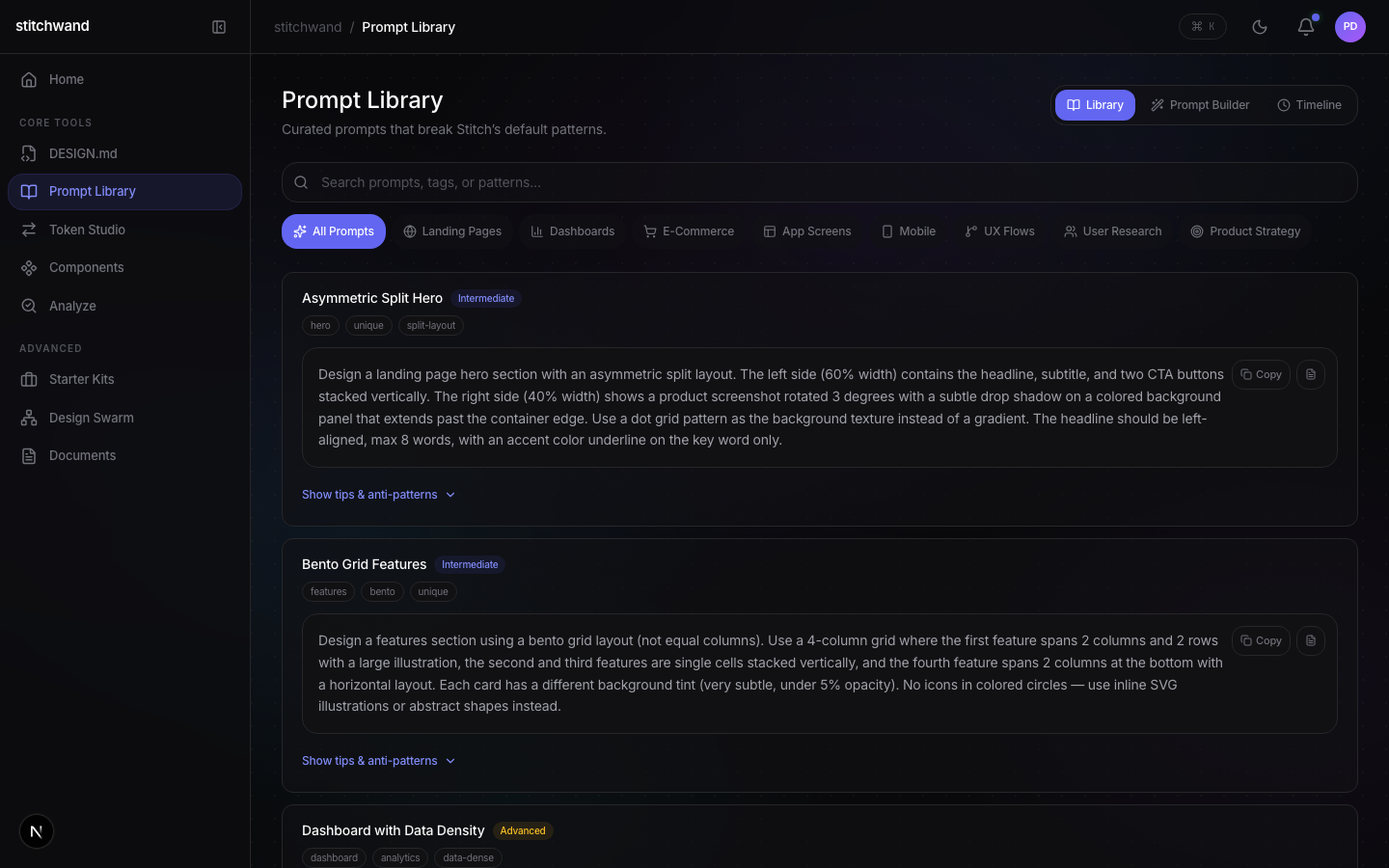
- Advanced Tools (Prompt Library with Timeline, Documents, Design Systems)
- Starter Kits, Design Swarm, and Documents (locked for Free with lock icons + "Pro" badge)
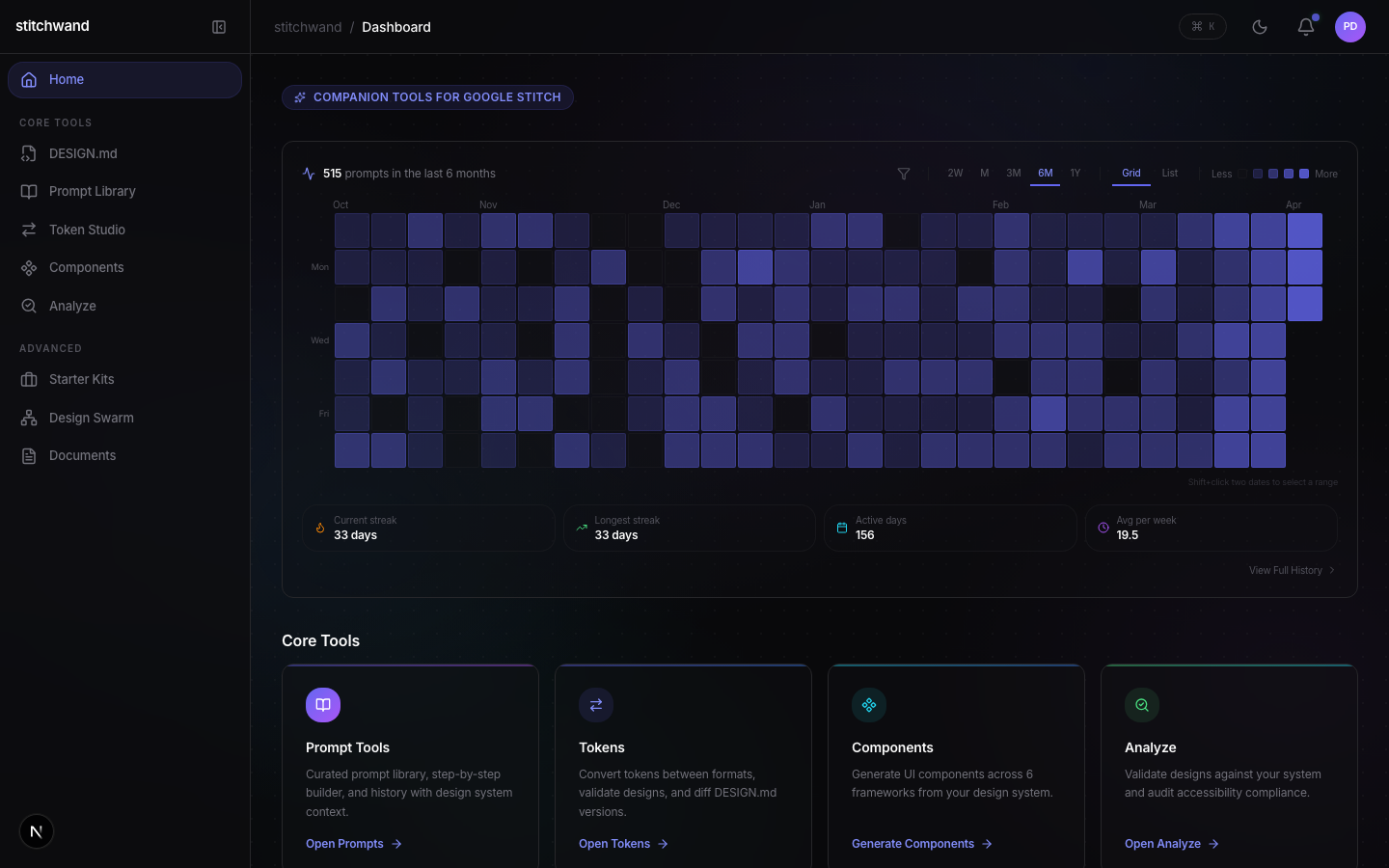
- Activity Graph with auto-seeded demo data, 2W/M/3M/6M/1Y time ranges (calendar-tile view for shorter ranges, underline toggles, pipe-divided toolbar), and History Drawer (search, sort, filter, export)
- Prompt Detail Drawer (copy, notes, save-as-template, metadata)
- 99 community design libraries
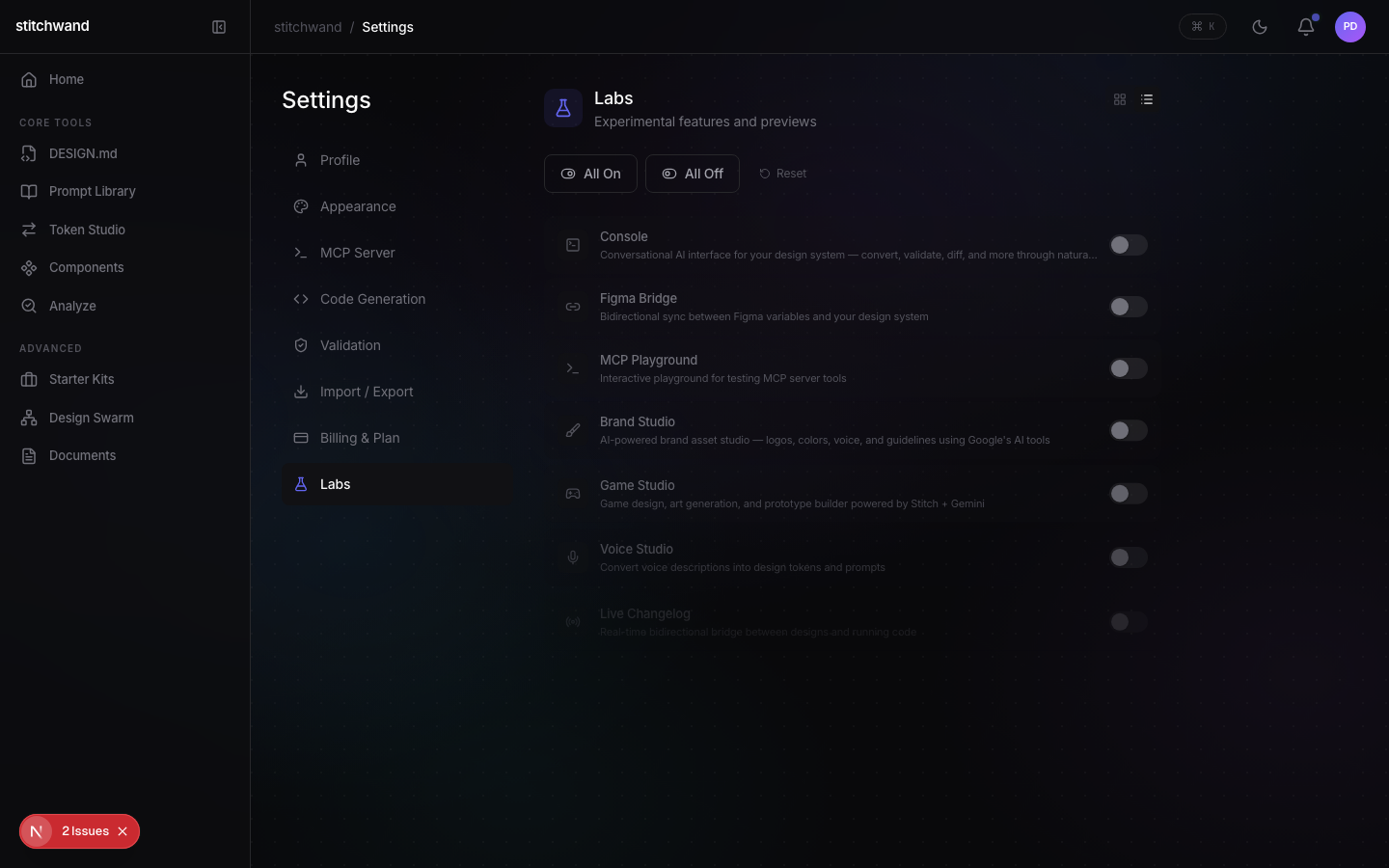
- Early access to experimental features
- Custom validation rules
- Token history and changelog
- Priority support (email)
Team
$49 /mo
For design ops teams that need collaboration, MCP integration, and shared infrastructure.
- Everything in Pro
- MCP server with full tool access
- Agent Hub — AI agent orchestration
- Shared design system workspaces
- Team member management and roles
- Usage analytics and dashboards
- CI/CD integration (GitHub Actions, GitLab)
- Webhook notifications
- Slack and Teams integration
- Up to 10 team members
Enterprise
Custom
For organizations that need compliance, security, and dedicated support.
- Everything in Team
- SSO (SAML, OIDC) integration
- Full audit log with export
- Dedicated customer success manager
- Custom integrations and workflows
- On-premise / VPC deployment option
- SLA with guaranteed uptime
- Custom validation rule development
- Training and onboarding workshops
- Unlimited team members
Pricing Rationale
Revenue Model
Open Core + SaaS Hybrid
The free tier drives adoption and community. Pro captures individual power users at a price point below their expense approval threshold. Team captures departmental budgets. Enterprise captures procurement-led deals.
- Free-to-Pro conversion target: 4-6% of active CLI users
- Pro-to-Team upsell target: 15-20% of Pro accounts
- Average Revenue Per Account (ARPA): $58/mo blended
- Target Net Revenue Retention: 115%+
Competitive Positioning
Price vs. Value Anchoring
Specify charges $200+/mo for similar functionality without AI features or MCP integration. Tokens Studio is free but limited. We sit in the sweet spot: more powerful than free alternatives, significantly cheaper than enterprise platforms.
- Specify: $200-800/mo (enterprise design token platform)
- Tokens Studio: Free / $15/mo (Figma-focused, no CLI)
- Style Dictionary: Free (config-heavy, no web UI, no AI)
- stitchwand Pro: $19/mo, Team: $49/mo (AI-native, full-stack, Stitch companion)
Revenue Projections
| Metric |
Phase 1 (Q2 '26) |
Phase 2 (Q3 '26) |
Phase 3 (Q4 '26) |
Phase 4 (Q1 '27) |
| Free Users |
800 |
2,500 |
6,000 |
12,000 |
| Pro Subscribers |
0 |
40 |
200 |
500 |
| Team Subscribers |
0 |
0 |
25 |
80 |
| Enterprise Contracts |
0 |
0 |
0 |
3 |
| MRR |
$0 |
$1,160 |
$8,280 |
$29,420+ |
| ARR Run Rate |
$0 |
$13,920 |
$99,360 |
$353,040+ |
Launch Plan
A four-phase approach from free tools foundation to enterprise revenue. Each phase builds on the prior, with clear milestones that gate advancement.
Phase 1 — Q2 2026
Free Tools Foundation
Ship the CLI and core library as free npm packages. Establish npm presence, build community, and validate core functionality with early adopters. Focus ruthlessly on developer experience — the CLI must feel magical from the first npx stitchwand command.
npm publish @stitchwand/cli
npm publish @stitchwand/core
Documentation site launch
README + docs site
DTCG, CSS, Style Dictionary conversion
Token validation rules engine
Diff with rich terminal output
CI/CD integration template
Product Hunt launch
Dev.to + Hashnode launch posts
1,000
npm weekly downloads
Phase 2 — Q3 2026
Web App + Stitch Ecosystem
Launch the web app in beta. Submit to the Google Stitch Skills marketplace. Begin the early adopter program with 50-100 design system teams. This is the validation phase — product-market fit or pivot.
Web app beta launch
Stitch Skills marketplace listing
Figma Bridge integration
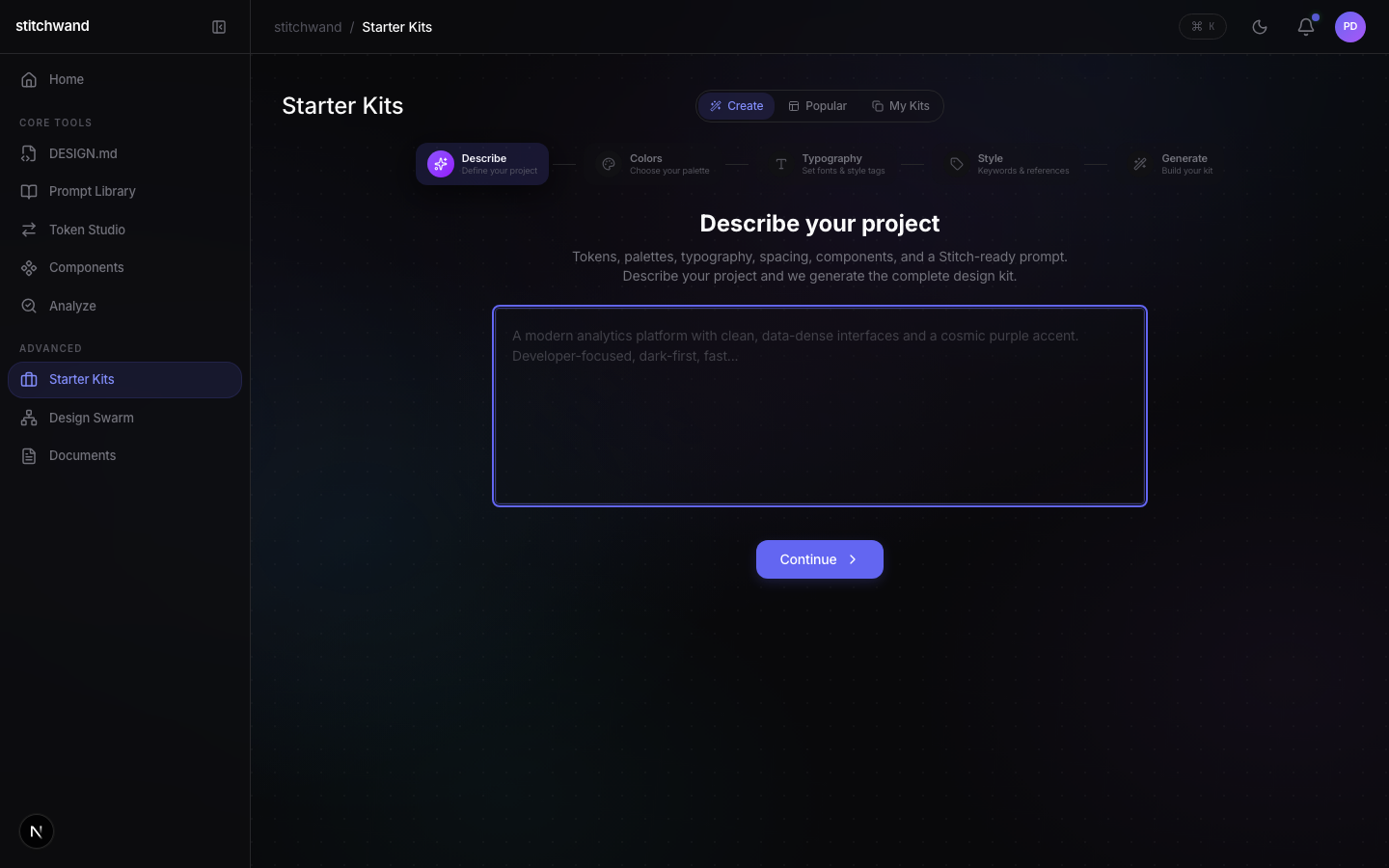
Starter Kits (Popular gallery + sticky header + 99 design libraries)
Activity Graph (2W/M/3M/6M/1Y, calendar-tile view, underline toggles) + auto-seeded demo data + History Drawer
Free/Pro tier gating with sidebar lock icons
Animated demo fill ('v' shortcut)
Prompt Detail Drawer + Timeline View
Documents (12 document types)
Token Playground
Early adopter program (100 seats)
User interview program
Blog content series launch
First conference talk (proposal)
Discord community buildout
2,500
npm weekly downloads
Phase 3 — Q4 2026
Pro Tier + MCP Launch
Launch the Pro subscription tier. Publish the MCP server to npm and all major directories. Begin monetization with a target of $25K MRR by end of quarter. Content marketing goes into high gear.
Pro tier launch + Stripe billing
MCP server npm publish
MCP directory listings
AI Audit feature
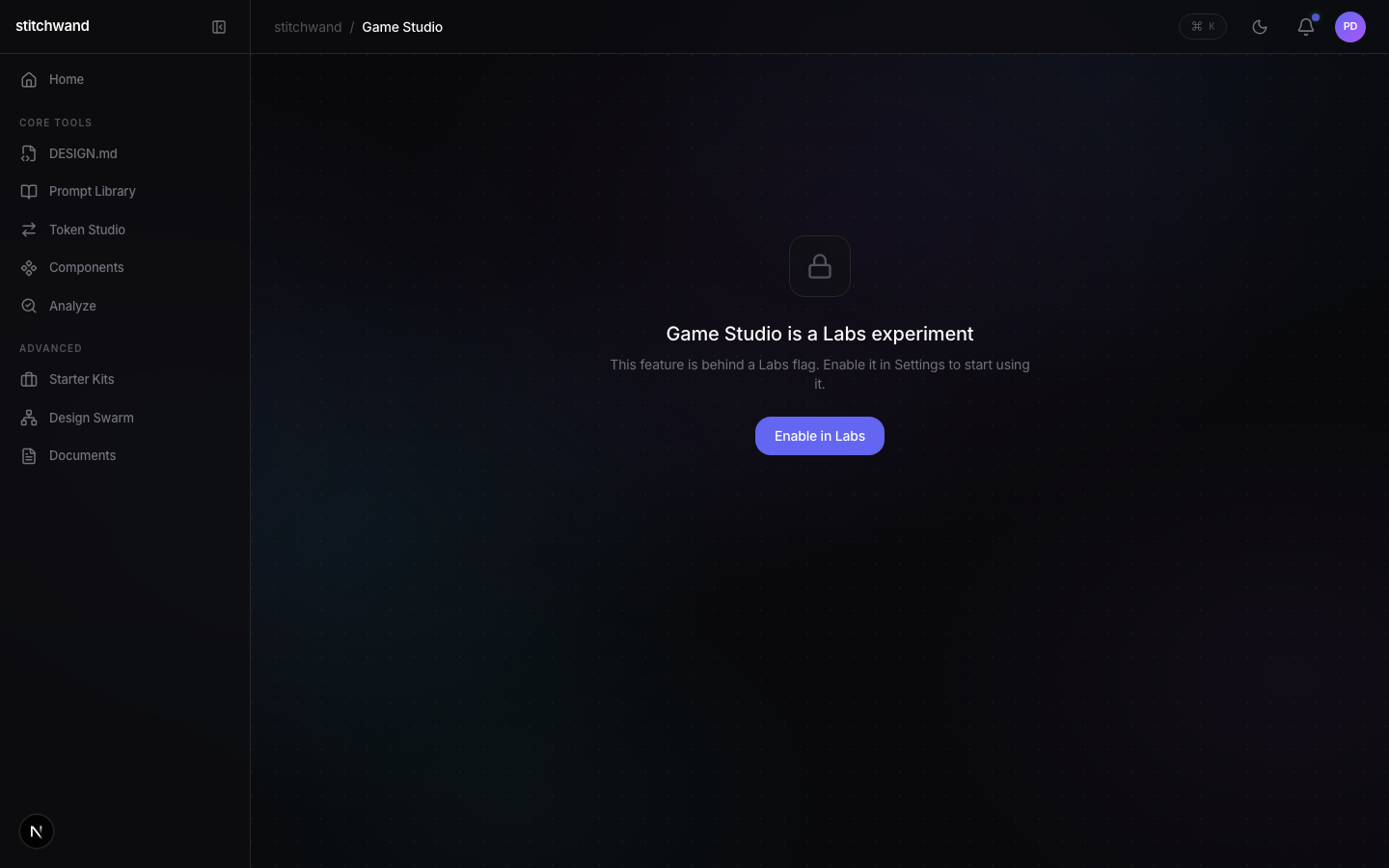
Game Studio feature
Custom validation rules
Token history + changelog
YouTube channel launch
SEO content push (20 articles)
Conference circuit begins
5,000
npm weekly downloads
$8.3K
Monthly recurring revenue
Phase 4 — Q1 2027
Team Tier + Enterprise
Launch the Team tier with shared workspaces and Agent Hub. Begin enterprise pilot conversations. Target 3 enterprise contracts signed by end of quarter. This phase is about proving the business model scales.
Team tier launch
Agent Hub (AI orchestration)
Shared design system workspaces
Team analytics dashboard
CI/CD integrations (GitHub Actions, GitLab)
Enterprise SSO (SAML)
Audit logging
3 enterprise pilot programs
Partnership deals signed
Series seed fundraise (if applicable)
10,000
npm weekly downloads
$29K+
Monthly recurring revenue
Launch Readiness Checklist
Product
Before Phase 1 Launch
- CLI supports all 4 core token formats
- 80%+ test coverage on @stitchwand/core
- Zero critical bugs in validation engine
- README with quickstart, examples, API docs
- GitHub repo with issue templates, contributing guide
- npm package with correct metadata and keywords
- Landing page live at stitchwand.com
Marketing
Before Phase 1 Launch
- Product Hunt launch queued and scheduled
- 3 launch blog posts drafted (announcement, tutorial, deep-dive)
- Twitter/X account active with 2 weeks of content queued
- Discord server set up with channel structure
- Dev.to + Hashnode cross-posts prepared
- Email list capture on landing page
- Press outreach to 10 design/dev publications
KPI Dashboard
Key performance indicators organized by the pirate metrics framework (AARRR). These are our Phase 3 targets — the numbers that determine whether we're on track.
Acquisition
npm Weekly Downloads
5,000
Target by Q4 2026
GitHub Stars
2,000
Target by Q4 2026
Web App Signups
3,000
Target by Q4 2026
MCP Server Installations
500
Target by Q4 2026
Activation
First Conversion (CLI)
72%
% of installers who run convert
First Validation
58%
% of installers who run validate
First Starter Kit Gen
45%
% of web users who try Starter Kits
Time to First Value
<90s
Install to first conversion output
Revenue
Monthly Recurring Revenue
$29K
Target by Q1 2027
Free-to-Pro Conversion
4.5%
Target conversion rate
Monthly Churn Rate
<5%
Target gross churn
Net Revenue Retention
115%
Target NRR (expansion > churn)
Engagement
DAU / MAU Ratio
28%
Target stickiness ratio
Features Per Session
3.2
Average tool uses per session
MCP Tool Calls / Day
2,400
Target across all MCP users
Session Duration (Web)
8.5m
Average minutes per session
Referral & Growth
Discord Members
1,500
Target by Q4 2026
Twitter/X Followers
5,000
Target by Q4 2026
Organic Referral Rate
22%
% of signups from word-of-mouth
GitHub Contributors
35
Target by Q4 2026
Competitive Landscape
stitchwand operates at the intersection of design token tooling, AI-native design infrastructure, and MCP-enabled developer tools. No existing product covers all three categories.
Competitive Matrix
| Product |
Type |
Token Convert |
Validation |
Diff |
AI Features |
MCP |
Stitch |
Pricing |
| stitchwand |
Us |
Yes — all formats |
Yes — rules engine |
Yes — visual |
Yes — native |
Yes — first |
Yes — companion |
Free / $19+ |
| Style Dictionary |
Direct |
Yes — config-heavy |
No |
No |
No |
No |
No |
Free (OSS) |
| Specify |
Direct |
Yes — limited |
Basic |
No |
No |
No |
No |
$200+/mo |
| Tokens Studio |
Direct |
Figma-centric |
Basic |
Basic |
No |
No |
No |
Free / $15 |
| Figma Dev Mode |
Adjacent |
CSS only |
No |
No |
Basic |
No |
No |
$5/editor/mo |
| Storybook |
Adjacent |
No |
No |
No |
No |
No |
No |
Free (OSS) |
| Chromatic |
Adjacent |
No |
No |
Visual only |
Basic |
No |
No |
Free / $149+ |
Direct Competitors
Direct Competitor
Style Dictionary (Amazon)
Open source token build system maintained by Amazon. The incumbent for token conversion. Config-file driven, powerful but complex. No web UI, no validation, no diffing, no AI features.
- Strength: Large community, battle-tested, Amazon backing
- Weakness: Config-heavy, steep learning curve, no innovation in 2+ years
- Our edge: Zero-config CLI, AI-native, Stitch companion, web UI
Direct Competitor
Specify
Enterprise design token platform with Figma integration and distribution pipelines. VC-funded, Paris-based. Strong enterprise features but expensive and slow-moving on AI.
- Strength: Enterprise features, Figma sync, team collaboration
- Weakness: Expensive ($200+/mo), no CLI, no MCP, no Stitch support
- Our edge: 7x cheaper, free core tools, MCP-first, Stitch-native
Direct Competitor
Tokens Studio
Popular Figma plugin for managing design tokens. Strong community in the Figma ecosystem. Recently launched a separate web platform with limited features.
- Strength: Deep Figma integration, active community, affordable
- Weakness: Figma-dependent, limited conversion formats, no AI, no MCP
- Our edge: Platform-agnostic, full CLI, MCP server, Stitch companion
Adjacent Competitors
Adjacent
Figma Dev Mode
Figma's built-in developer handoff. Provides basic CSS output and code snippets. Not a token management tool, but captures some of the same "design-to-code" workflow. Limited to CSS output format and Figma ecosystem.
Adjacent
Storybook + Chromatic
Component documentation and visual testing. Storybook catalogs components; Chromatic catches visual regressions. Complementary to stitchwand rather than competitive. Potential partnership opportunity for token-aware visual testing.
stitchwand Advantages
AI-Native Architecture
Built from day one with AI workflows in mind. Starter Kits generates tokens from natural language with 99 design libraries (Twitch, Discord, Netflix, Slack, YouTube, and more) and an animated demo fill shortcut ('v') that types words one at a time with sparkle effects. AI Audit catches issues humans miss. Activity Graph auto-seeds 500 prompt entries + 200 analytics events for a populated demo experience from day one, with a GitHub-style heatmap, calendar-tile view for shorter ranges (2W/M), five time ranges (2W/M/3M/6M/1Y, default 6M), underline-style toggles, pipe-divided toolbar, and full history drawer. Free/Pro tier gating lets users try the product before upgrading, with lock icons and "Pro" badges on advanced tools. Documents generates 12 doc types. No competitor has meaningful AI features.
MCP-First Distribution
The only design token tool with an MCP server. Every AI code editor (Cursor, Claude, Windsurf) becomes a distribution channel. Developers discover stitchwand through their AI assistant. Zero competition in this channel.
Stitch Companion Status
Purpose-built for Google Stitch. First-mover in the Stitch Skills marketplace. As Stitch grows, we grow with it. Every Stitch user who needs token management is a qualified lead. We ride the Stitch adoption curve.
Full-Stack Coverage
CLI for terminals, MCP server for AI editors, web app with Console for visual workflows, and a TypeScript SDK for programmatic use. 25+ features across Core, Advanced, and Labs tiers including activity tracking with auto-seeded demo data (2W/M/3M/6M/1Y time ranges, calendar-tile view, underline toggles), timeline views, prompt detail drawer, Free/Pro tier gating with lock icons, and 99 design libraries. Developers use what fits their workflow; we're always available.
Free Core Tools
Core library and CLI are free to use. Developers can trust a tool that's free forever with no bait-and-switch. Style Dictionary proved that free wins in this category. We follow the same playbook with 10x better DX.
Speed to Value
Under 90 seconds from install to first conversion output. No config files required. No build step. No account needed for the free tier. The fastest path from "I have tokens" to "I have production-ready output."
Competitive Risk Factors
| Risk |
Likelihood |
Impact |
Mitigation |
| Google builds token tools into Stitch natively |
Medium |
High |
Move fast, build community moat, diversify beyond Stitch |
| Figma adds DTCG export |
High |
Medium |
Validation + diff + AI features not easily replicated |
| Style Dictionary v5 modernizes |
Medium |
Medium |
Our AI/MCP/web features create a different category |
| New VC-funded competitor enters |
Low |
Medium |
First-mover + developer community is defensible |
| Stitch adoption is slower than expected |
Medium |
Medium |
Tool is platform-agnostic; Stitch is a channel, not a dependency |
Paid Acquisition
Full paid advertising playbook for a first-time advertiser. Accounts, targeting, geo-fencing, billing, exact spend. Peaks during Google Cloud Next April 21-24, 2026 in Las Vegas.
Budget Overview
Campaign Strategy
Four phases from soft launch to cool down, peaking during Google Cloud Next in Las Vegas. Code ships April 18, ads start April 21. LinkedIn for job-title targeting (design system pros), X for keyword targeting (people discussing Google Stitch). Total budget $600-800, with a $200 minimum viable option.
Platform Strategy
LinkedIn
Job Title + Skills Targeting
Best for reaching "Senior Frontend Engineers at SaaS companies." Target by job function (Design, Engineering, Product), skills (Design Systems, Figma, Google Cloud Platform, React.js, Tailwind CSS, Design Tokens), and seniority (Senior+). City-level geo-fencing for conference targeting. Run ads from the Fieldhaus company page; boost posts from Brian's personal page.
- Campaign Manager at linkedin.com/campaignmanager
- Min $10/day budget
- CPC benchmark: $3-6, CPM: $28-33
- Good CTR: 0.5%+
X (Twitter)
Keyword + Interest Targeting
Best for reaching "people who tweeted about Google Stitch." Target by keywords (#GoogleCloudNext, "Google Stitch", "design tokens", "DESIGN.md") and follower lookalikes (@googlecloud, @tailwindcss, @anthropic, @figma). Geo + keyword combo is the tightest conference proxy available. Run ads from @stitchwand.
- Ads Manager at ads.x.com
- Autobid recommended
- CPC benchmark: ~$0.74, CPM: ~$2
- Good CTR: 1%+
Targeting Limitation
You can't target "conference attendees" directly on either platform. Proxy strategy: Las Vegas geo during conference + tech job titles on LinkedIn; Las Vegas geo + #GoogleCloudNext keywords on X catches people both in Vegas AND discussing the event.
Campaign Phases
Phase 1
Soft Launch — Apr 21-25
$15/day total. Test creative, learn what works.
- LinkedIn "Design System Pros" — $10/day nationwide
- X "Stitch Keywords" — $5/day nationwide
- After 3 days: CTR > 0.3%? CPC < $8? Keep it. Otherwise swap creative.
Phase 2
Ramp Up — Apr 19-21
$35/day + $75 boost. Double budgets, add demo video.
- LinkedIn $10 → $20/day, X $5 → $10/day
- Boost best organic post from personal page — $75 over 7 days
- Add full demo video as second ad (platforms A/B test automatically)
Phase 3
Peak / Geo-Fence — Apr 21-25
$90/day. Conference geo-fencing + nationwide.
- LinkedIn geo Las Vegas + tech jobs — $40/day (Brand Awareness objective)
- X geo Las Vegas + #GoogleCloudNext keywords — $20/day
- Keep nationwide running: LinkedIn $20 + X $10 = $30/day
Phase 4
Cool Down — Apr 26-30
$20/day. Retarget warm visitors.
- Pause geo campaigns
- Reduce nationwide: LinkedIn $10 + X $5
- Launch retargeting campaign — $5/day (needs 300+ visitors)
- Retargeting = 3-5x conversion vs cold traffic
Budget Breakdown
| Campaign |
Dates |
$/Day |
Days |
Max |
| Soft Launch — LinkedIn |
4/21-25 |
$10 |
6 |
$60 |
| Soft Launch — X |
4/21-25 |
$5 |
6 |
$30 |
| Ramp — LinkedIn |
4/19-21 |
$20 |
3 |
$60 |
| Ramp — X |
4/19-21 |
$10 |
3 |
$30 |
| Organic Boost |
4/19 |
— |
— |
$75 |
| Peak — LinkedIn geo |
4/21-25 |
$40 |
5 |
$200 |
| Peak — X geo |
4/21-25 |
$20 |
5 |
$100 |
| Peak — LinkedIn nationwide |
4/21-25 |
$20 |
5 |
$100 |
| Peak — X nationwide |
4/21-25 |
$10 |
5 |
$50 |
| Cool Down — all |
4/26-30 |
$20 |
5 |
$100 |
| Maximum Total |
$805 |
| Realistic Range |
$560-685 |
Ad Copy Templates
LinkedIn — Nationwide
Soft Launch Copy
Option A: "I tried to build an app in Google Stitch. 10 times. Every version ignored my design system. So I built the bridge between your tokens and Stitch. → stitchwand.dev"
Option B: "Your design system has 2,000 tokens. Google Stitch has no idea they exist. stitchwand converts your tokens into DESIGN.md so Stitch generates on-brand. → stitchwand.dev"
Headline: "Design system toolkit for Google Stitch"
LinkedIn — Geo-Fence
Conference Copy
Option A: "At Google Cloud Next? Every AI generator ignores your design system. stitchwand fixes that. Your tokens → DESIGN.md → on-brand Stitch output. → stitchwand.dev"
Option B: "Seeing Stitch demos this week? Cool. Now make it respect YOUR brand. → stitchwand.dev"
Headline: "Make Stitch respect your tokens"
X — All Campaigns
X Ad Copy
Option A: "npx stitchwand convert ./tokens.json → DESIGN.md. Your design system, Stitch's language. stitchwand.dev"
Option B: "Google Stitch generates fast. But it doesn't know your brand. stitchwand bridges the gap. Free CLI. stitchwand.dev"
Conference: "At #GoogleCloudNext? Your design tokens → DESIGN.md → on-brand Stitch. Try it: stitchwand.dev"
Creative Specs
| Platform |
Format |
Size |
Notes |
| LinkedIn |
Single image |
1200 x 628px |
2:1 ratio. PNG or JPG. |
| LinkedIn |
Square video |
1080 x 1080px |
MP4. Under 10 min. 30-60s ideal. |
| LinkedIn |
Landscape video |
1920 x 1080px |
16:9. Square gets more feed real estate. |
| X |
Single image |
1200 x 675px |
16:9. PNG or JPG. |
| X |
Square image |
1080 x 1080px |
1:1. Works well in mobile feed. |
| X |
Video |
1080 x 1080px |
MP4. Under 2:20. 30-60s ideal. |
Pro Tip
Use your sizzle reel videos as ad creative. Export 1080x1080 square for both platforms. One export, two platforms.
Setup Checklist
LinkedIn Setup
Campaign Manager + Insight Tag
- linkedin.com/campaignmanager → "For Business" → "Advertise"
- Connect Fieldhaus company page (required for ads)
- Add credit card — not charged until ads run, min $10/day
- Install Insight Tag on stitchwand.dev (Account Assets → Insight Tag → JS snippet in Next.js layout.tsx). Every organic visitor becomes retargetable.
- CRITICAL: Disable LinkedIn Audience Network on EVERY campaign. Enabled by default, shows ads on random apps. Saves 30-50% wasted budget.
X Setup
X Ads + Pixel
- ads.x.com → US, Eastern timezone. Add card.
- Install X Pixel on stitchwand.dev (Tools → Events Manager)
Tracking
UTM Parameters
Every ad URL needs UTM parameters for PostHog/Plausible attribution.
- Format: stitchwand.dev?utm_source=linkedin&utm_medium=paid&utm_campaign=soft-launch
- Use different utm_campaign values per campaign
- Verify LinkedIn Insight Tag and X Pixel are firing (browser dev tools → Network tab)
Monitoring & Optimization
Daily Check (2 min)
Key Metrics
- Spend — on budget?
- CTR — below 0.3% on LinkedIn or 0.5% on X = swap creative
- CPC — above $8 on LinkedIn = broaden targeting
- Impressions — under 500/day = audience too small
Stop Thresholds
When to Pause
- CTR below 0.2% after 3 days
- $100 spent with zero site visits
Go Thresholds
When to Scale
- CTR above 1%
- CPC under $3 on LinkedIn
A/B Testing
Run 2 ads per campaign with ONE difference. LinkedIn and X split traffic automatically. Test creative format (video vs static), hook style (story-driven vs benefit-driven), and CTA (website link vs npm install). Call a winner after 500+ impressions per variant or 3 days, whichever comes first. Pause the loser, keep the winner, start a new challenger.
Minimum Viable Plan — $200
If you only have $200
1. Install LinkedIn Insight Tag today (free — every organic visitor becomes retargetable).
2. Boost your best organic post — $75 over 7 days.
3. LinkedIn geo-fence during conference — $125 (5 days x $25/day).
Total: $200. If you only do ONE paid thing, boost your best post. You know it works — just show it to more people.
Social Accounts
Create
@stitchwand on X
Devs find tools on X. Product handle for CLI demos, changelogs, release notes. Bio: "Design system toolkit for Google Stitch. Free CLI. Built by @fieldhaus."
Skip
No LinkedIn Company Page
Zero-follower company pages get zero reach. Splits audience across three pages for no benefit. Brian (12K followers) + Fieldhaus is plenty.
| Account |
Platform |
Use For |
Ads From |
| Brian |
LinkedIn |
Hot takes, build-in-public (primary reach) |
Boost personal posts |
| Fieldhaus |
LinkedIn |
Official product posts, Brian reshares |
Campaign ads + retargeting |
| Brian |
X |
Conference live-tweeting, threads |
— |
| @stitchwand |
X |
CLI demos, changelogs, dev community |
X ad campaigns |
Post-Campaign Analysis
After April 30
Metrics to Pull
Pull from Campaign Manager + PostHog: total spend, total clicks, total impressions, avg CPC, avg CTR, site visits from ads (UTM filtered), npm installs during campaign period, active users during period, Fieldhaus leads generated.
- ROI calculation: Total spend / Fieldhaus leads = cost per lead
- One engagement ($1,800/wk x 12 wks = $21,600) / total spend = ROI multiple
- Even one lead from $800 spend = 27x return
- Save: which campaign had best CTR, which creative won, which targeting worked — this is your baseline for next launch